
close
Choose Your Site
Global
Social Media
Views: 50000 Author: bella Publish Time: 2026-09-24 Origin: Site


Electric vehicle battery systems must balance several engineering priorities at the same time: thermal control, structural integrity, low weight, serviceability, and repeatable assembly. The parts that support these systems may look simple at first glance, but their performance depends on accurate interfaces, reliable sealing surfaces, controlled channels, and consistent production quality.
That is where CNC machining for EV battery components becomes valuable. CNC milling and turning can produce the metal housings, cooling plates, manifolds, brackets, connectors, and fixtures required during battery development and production. More importantly, the process gives engineering teams a practical way to move from a CAD concept to functional, inspectable components without losing control of material and dimensional requirements.

Precision-machined cooling plates and manifolds support the mechanical and thermal architecture of EV battery systems.
Battery-related components often combine functional surfaces with complex internal or external features. A supplier must understand more than the basic part shape.
Battery packs and thermal-management systems contain multiple connected components. Mounting faces, bolt patterns, connector openings, and sealing interfaces must align with the surrounding assembly. CNC machining makes it possible to define these features directly from engineering drawings and 3D CAD data, with inspection focused on the dimensions that affect fit and function.
Cooling plates and manifolds may include channels, ports, grooves, and connection points. These features must be machined with a clear process plan so that tool access, wall thickness, burr control, and inspection requirements are considered before production.
Aluminum is frequently considered for battery housings, brackets, cooling components, and prototype structures because it combines low weight with useful machinability and thermal conductivity. The correct material and geometry still depend on the application, operating environment, joining method, and engineering specification.
EV programs often evolve through several design revisions. A CNC supplier that provides DFM feedback, material documentation, and inspection reports can help the engineering team identify manufacturing risks before they become assembly or validation problems.
Cooling plates can be designed with machined channels, ports, sealing surfaces, and mounting features. The manufacturing plan should address channel accessibility, corner radii, burr removal, leak-test requirements, and the final surface condition of critical interfaces.
Manifolds connect fluid paths within a thermal-management system. Their performance depends on the accuracy of ports, threaded holes, internal passages, and sealing faces. A detailed drawing should identify which features are functionally critical and which can use general tolerances.
CNC-machined housings and covers can be used for prototypes, low-volume programs, testing fixtures, and specialized assemblies. Engineers should review wall thickness, pocket depth, fastening features, gasket locations, and the accessibility of internal surfaces during the design stage.
These parts connect modules, sensors, cooling assemblies, and test equipment. Their design may prioritize weight reduction, stiffness, alignment, or rapid modification. Standardized holes and simplified setups can reduce manufacturing complexity while preserving the required function.
Sensor mounts and connector interfaces often require accurate positioning and clean edges. These features should be clearly marked on the drawing so the supplier can apply the correct inspection method and avoid confusing cosmetic requirements with functional requirements.
Material selection should follow the part's real operating conditions rather than a generic preference. When requesting an EV battery component quote, define the following points:
Required strength and stiffness
Weight or packaging constraints
Thermal conductivity requirements
Contact with coolant, moisture, or chemicals
Electrical isolation or conductivity requirements
Surface-treatment compatibility
Expected production volume and inspection level
Aluminum alloys may be suitable for lightweight thermal and structural parts, while stainless steel or engineering plastics may be more appropriate for other interfaces and environments. Ronghang Hardware's available material range includes aluminum, stainless steel, carbon steel, brass, titanium, and plastics. The final selection should always follow the customer's approved engineering specification.

Tool access, channel geometry, fixture stability, and burr control should be reviewed before machining begins.
A focused DFM review can reduce avoidable machining time and improve production consistency. Before submitting your CAD files, check the following:
Identify functional features: Mark sealing faces, mounting datums, ports, and connector interfaces.
Review channel accessibility: Confirm that the planned tool can reach cooling channels and internal pockets.
Add practical internal radii: CNC tools are cylindrical, so sharp internal corners may require special strategies or secondary work.
Avoid unnecessarily deep pockets: Deep features can increase tool deflection, vibration, and machining time.
Use standard holes and threads where possible: Common tooling can simplify setup and reduce process changes.
Separate cosmetic and functional requirements: Not every surface needs the same finish or tolerance.
Plan sealing surfaces carefully: Specify flatness, roughness, and dimensional requirements only where they affect sealing performance.
Reduce unnecessary setups: A design that can be accessed from fewer orientations is generally easier to fixture and inspect.
Consider post-processing early: Anodizing, passivation, deburring, cleaning, or other treatments can affect dimensions and lead time.
Request a manufacturability review: A supplier should identify risks before production, not after a failed first article.
Quality control should be connected to the function of the part. Depending on the drawing and project requirements, an EV component inspection plan may include:
Dimensional inspection of critical features
Flatness and position checks for mounting and sealing surfaces
Thread and port verification
Surface-roughness checks where specified
Material certification and batch traceability
First Article Inspection or dimensional reports
Visual inspection for burrs, scratches, and machining damage
The inspection method should match the tolerance and feature. A supplier should be able to explain how each important dimension will be measured and reported rather than simply providing a general quality statement.
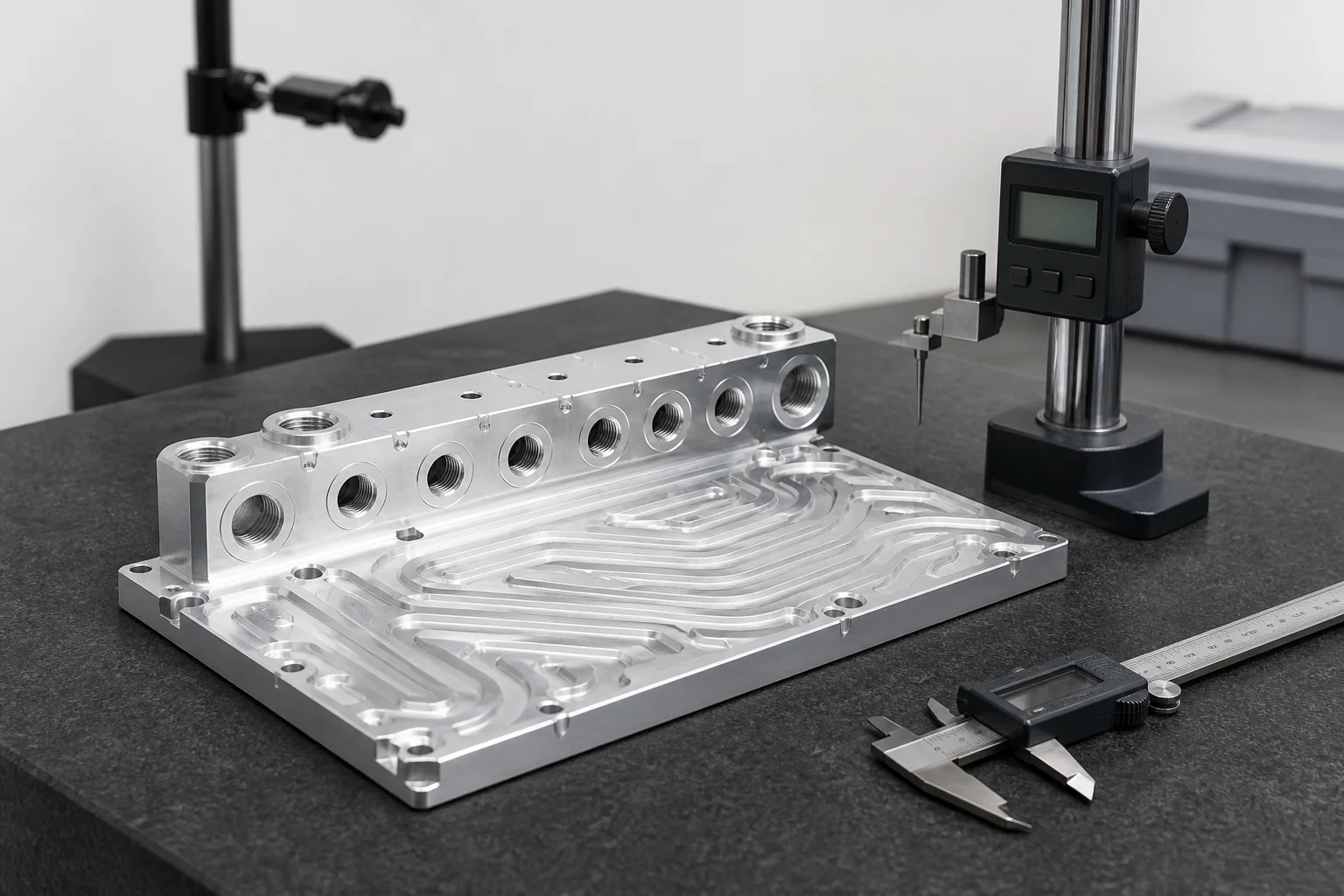
Inspection documentation helps engineering and procurement teams review component consistency before assembly.
When comparing suppliers, ask practical questions that reveal manufacturing readiness:
Can the supplier machine the requested material and part envelope?
How will the supplier inspect channels, ports, flatness, and critical interfaces?
What DFM feedback is included before production?
Can the supplier support prototypes, low-volume builds, and repeat orders?
Which surface treatments, cleaning steps, and secondary processes are available?
What documents will be provided with the shipment?
How are drawing revisions and approval changes controlled?
A useful supplier is not simply the company offering the lowest initial quote. The better choice is the partner that can explain the process, identify risks early, and provide evidence that the finished parts match the approved requirements.
Ronghang Hardware provides CNC milling and turning, rapid prototyping, surface treatment coordination, and OEM/ODM manufacturing support for customized metal and plastic parts.
For EV battery and thermal-management projects, our engineering team can review CAD files and drawings before quotation. The review can focus on material selection, tool access, fixture strategy, critical dimensions, surface treatment, and inspection requirements.
Available capabilities and services include:
CNC milling and turning for customized components
3-axis, 4-axis, and 5-axis machining options
Aluminum, stainless steel, titanium, brass, and engineering plastics
Precision machining capability down to the project's specified tolerance
DFM feedback before production
Inspection documentation and material-related records according to project requirements
OEM/ODM support from prototype development through production planning
Project requirements should be confirmed from the customer's drawings, specifications, and approved quality documents before manufacturing begins.
Common examples include cooling plates, coolant manifolds, battery housings, covers, brackets, sensor mounts, connector interfaces, and testing fixtures. The final process depends on the part geometry, material, quantity, and inspection requirements.
Aluminum can be a practical option for many lightweight thermal and structural components, but suitability depends on the required strength, thermal behavior, corrosion environment, joining method, and engineering specification.
Yes, CNC machining can produce accessible channels, grooves, ports, and related features. The channel geometry should be reviewed for tool access, corner radii, wall thickness, burr control, cleaning, and inspection before production.
A 3D CAD model is useful for geometry, while a 2D drawing communicates tolerances, datums, surface requirements, materials, finishes, and inspection notes. Quantity and target delivery requirements should also be included when available.
Start with a DFM review. Use practical radii, standard holes and threads, accessible features, limited setups, appropriate general tolerances, and a material size that reduces unnecessary waste. Keep tight requirements only on features that affect performance or assembly.
Have a cooling plate, manifold, housing, bracket, or custom battery component in development?
Send your CAD file and drawing to Ronghang Hardware for a project review. Our engineers can help evaluate manufacturability, material options, critical features, and the most suitable CNC process for your application.
Request a Quote / Upload Your CAD Drawing
Email: ronghang@ronghang.top
WhatsApp: +86-13724518832
Tags: CNC machining for EV battery components, EV battery cooling plate machining, CNC aluminum battery parts, battery thermal management components, electric vehicle precision parts, EV component manufacturer


